
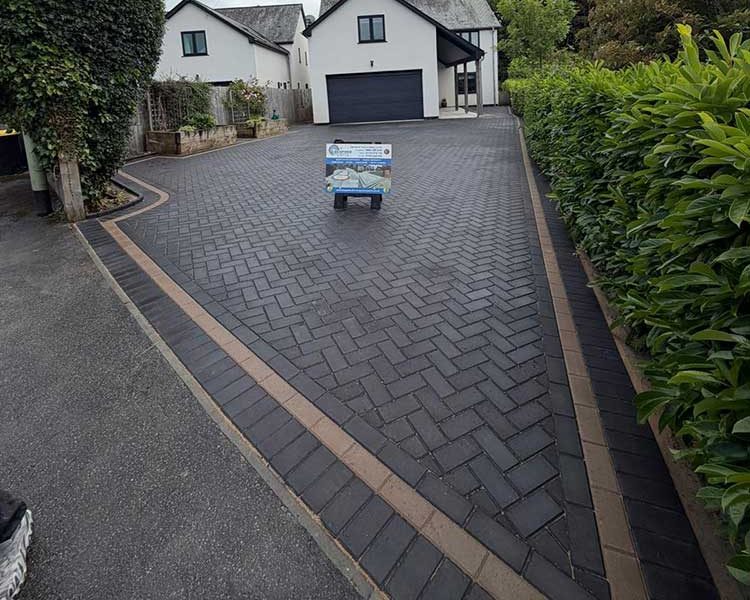
For a sloping driveway in Plymouth, start with three checks: how much grip the surface offers when wet, whether your car clears the changes in angle and where rainwater goes. Tarmac, resin bound surfacing and block paving can each suit different layouts. The steepest part of your driveway, especially where you turn or brake, is a better starting point than the look of a sample.
Check the gradient where you drive and park
Ask your installer to measure the slope at the entrance, any bend and the approach to the garage. The driveway might climb gently for most of its length but rise sharply just inside the gate. A car can scrape at that change in angle even when it has enough clearance along the rest of the drive. Point out where it happens and tell the installer which car you normally use.
Walk through a typical arrival. If you turn across the slope to reach a second bay, or struggle to open the car door once parked, explain that during the survey. The answer might be a gentler transition at the gate or a flatter parking area. Check where people walk from the car to the house as well, especially if they have to cross the steepest section.
Compare tarmac, resin bound and block paving
Tarmac provides a continuous finish without block joints. Ask to see the texture of the proposed surface, ideally on a comparable driveway, and check whether the specification suits the wet conditions at your steepest point. Standard dense tarmac sheds water, so the design needs a route for runoff. Porous asphalt is a different option and depends on the layers beneath it.
Resin bound surfacing uses stone aggregate mixed with resin. Ask for the name of the system and its suitability for the steepest measured gradient, vehicle use and wet conditions. If the installer proposes a permeable driveway, ask what happens to the water once it passes through the finish. The base and drainage design determine whether that water can be managed below the surface.
Block paving lets you choose the texture and can allow individual damaged blocks to be replaced. Its joints and edges deserve particular attention on a slope. The Association of Professional Landscapers’ guidance warns that heavy rain can wash jointing material out of block paving on steep drives. Ask how the edges will be restrained and what evidence supports the proposed system for your gradient.
Loose gravel can migrate downhill or move under tyres, particularly where cars brake or turn. If you like an aggregate finish, compare a bound surface with any gravel stabilisation system proposed for the measured slope.
Follow the water before choosing the finish
After rain, look for wet tracks or pooling from a safe spot. On a drive that slopes towards the house, check the garage threshold and any low points near doors. If it slopes towards the road, see whether runoff reaches the pavement. A channel drain can collect water at a low point, but ask where it discharges and how you would clear leaves and silt from it.
A permeable system also needs to account for the slope. The government’s guide to permeable front garden surfaces warns that permeable surfacing may be unsuitable on gradients steeper than 1 in 20. It separately recommends intercepting excess water where a drive slopes towards the house. For the broader planning and drainage considerations, see our driveway drainage guide.
Two layouts that call for different decisions
A short drive that drops towards a garage: A homeowner may want resin because they have heard it is permeable. The first thing to resolve is where water goes during heavy rain. The survey should also check the transition into the garage; adding a new surface layer changes the levels at the threshold. Once the drainage and clearance are understood, the installer can say which finishes fit the design.
A drive that climbs from the pavement and bends into a parking bay:
The bend matters because the car is turning as it climbs or descends. Ask the installer to check the wet surface specification and show how the outer edge will be restrained. If people walk up the same route, assess the footpath separately. A suitable vehicle surface does not automatically make the steepest walking route easy to use.
What to ask for in a driveway quote
Ask each installer to put the surface specification, base, edge restraints and drainage route in writing. If the quote includes changes at the entrance or garage, ask where the finished levels will sit. If the existing base is to stay, check what the installer will inspect before committing to reuse it. Those details make quotes easier to compare when they all name the same finish.
If you are comparing driveway surfaces in Plymouth, request a quote from Bespoke Driveways and Patios. Mention where your car scrapes or where water collects and, if available, share photos taken from the road and from the top of the drive.
Frequently asked questions
Is there a maximum slope for a resin bound driveway?
Use the gradient limit specified for the exact system proposed. Ask the installer to measure the steepest section, confirm that it falls within the manufacturer’s specification and explain any slip resistance requirements.
Can I make a steep driveway easier to use without flattening it?
Sometimes. The layout may allow a gentler change of angle at the entrance, a flatter section for parking or a separate walking route. The available length, levels and boundaries determine what is practical.
Should the footpath and driveway have the same finish?
They can, but assess pedestrian grip and the walking gradient separately. If the vehicle route is awkward on foot, ask whether a different alignment or steps could provide a more usable route.
Can resurfacing fix a driveway that scrapes the underside of my car?
Only if the new design corrects the change in angle that causes the scrape. An overlay may leave it unchanged or make it worse. Ask the installer to check proposed levels against the vehicle you use.