
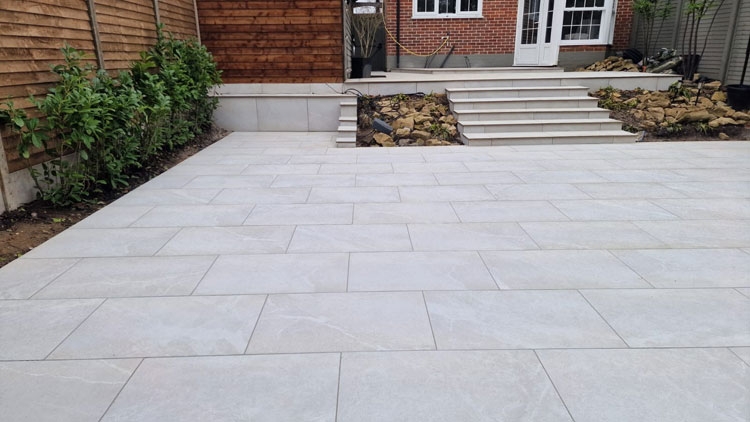
Start by checking what has moved. Crumbling joints between firm patio slabs may need repointing. A slab that rocks usually needs its support checked and may need to be lifted and relaid. If several slabs have sunk together, look for a problem with the base, edge support or levels before paying to replace the joints.
Tell joint damage from slab movement
Look along the patio from a firm edge. If the joints have gaps or loose material but the slabs sit flush and do not move, the damage may be limited to the joints. A raised corner, a slab that shifts in ordinary use or a distinct step between two slabs warrants a closer look. Keep foot traffic away from any obvious trip edge until it can be assessed.
Take one photo of the defect and another showing its position on the patio. A close view shows what has broken or shifted. A wider view can reveal whether several slabs are affected or whether the trouble starts at a step, drain or border. Take another photo after rain if water collects there. Pooling alone does not establish the cause, but a new puddle alongside sunken paving is useful evidence.
When repointing patio slabs is enough
Repointing replaces the material between the slabs. It can be enough when the paving is stable, the levels still work and the problem is limited to the joints. The old, loose material needs to come out to the depth required by the replacement product. A skim over a crumbling joint leaves the new material resting on the part that has already failed.
Choose the replacement material to suit the paving and the way it was laid. Check the product instructions for the required joint width and depth, bedding compatibility and weather conditions. For example, an outdoor porcelain patio with narrow joints may need a different product from sandstone with wider joints. Pavingexpert’s guide to re-jointing patios explains why the old joint and the type of paving matter when deciding how to repair it.
Where damage is confined to a few joints, a patch repair may make sense. If the surrounding joints are also breaking down, ask whether repointing a complete section would give a more consistent result. A new joint may look different from the old material, even when the paving itself stays in place.
When a loose slab needs lifting and rebedding
Bedding is the layer directly under each slab. A rocking slab may have lost its bond to that layer, or the layer itself may no longer provide even support. Fresh pointing can fill the visible gap while leaving the slab free to move. Pavingexpert’s guide to loose flagstones explains why a loose slab laid on mortar may need lifting and resetting on a full new bed.
If the slab comes up intact and the base underneath is sound, it may be possible to reuse it. Ask the installer how they will support the whole slab and bond it to the bedding. For porcelain laid on mortar, check the paving manufacturer’s installation instructions for the specified bedding and any bonding primer. The repaired slab should sit flush with its neighbours before the surrounding joints are filled again.
If the slab is cracked or damaged during lifting, ask about matching replacements before work starts. Natural stone varies in colour and texture, and weathered paving may look different beside a new slab from the same range. If a close match is unavailable, a replacement in a less visible position may be worth discussing.
When to investigate a larger area
Look beyond the individual slab if several have sunk together, the border is moving outwards or repaired joints keep opening. Ask the installer to check whether the bedding is sound, whether the outer edge still holds the paving in place and whether the sub-base beneath the bedding has settled. If the damage is near a downpipe or drain, ask them to check where water flows before deciding how much to lift.
If only a few slabs have moved and the surrounding paving is sound, a local repair may be enough. If a larger area has dropped or water now collects against the house, ask whether the levels or supporting layers need rebuilding in that area. A useful quote should tell you which slabs can stay, what must be lifted and what the installer will do if they uncover a wider defect.
What to share when asking for advice
Note when you first noticed the movement and whether the same joints have been repaired before. If the patio was recently installed, check the original paperwork and contact the installer before lifting slabs. Photos of the joints when dry and of any pooling after rain can help show what an inspection needs to cover.
If you are weighing up repair and replacement for a patio in Plymouth, contact Bespoke Driveways and Patios with photos and a short description of what has moved. Include whether the problem affects a single slab, several slabs or only the joints.
Frequently asked questions
Do weeds between patio slabs mean the base has failed?
No. Weeds can grow in gaps or in material that collects in the joints. Check whether the slabs themselves have moved before deciding how much work is needed.
Can I pressure wash the patio before repairing the joints?
Check the paving and jointing manufacturer’s guidance first. If joints are already breaking down, avoid directing a strong jet at them. Loose material can usually be cleared as part of preparing the joints for repair.
Can one patio slab be repaired without lifting the others?
Sometimes. If the problem is isolated and the neighbouring slabs and sub-base are sound, one slab can often be lifted and relaid. The joints around it will also need attention.
How soon can I walk on patio slabs after a repair?
Follow the curing and traffic guidance for the specific bedding and jointing products used. Ask the installer to confirm when the repaired area can take foot traffic and when furniture can go back.