
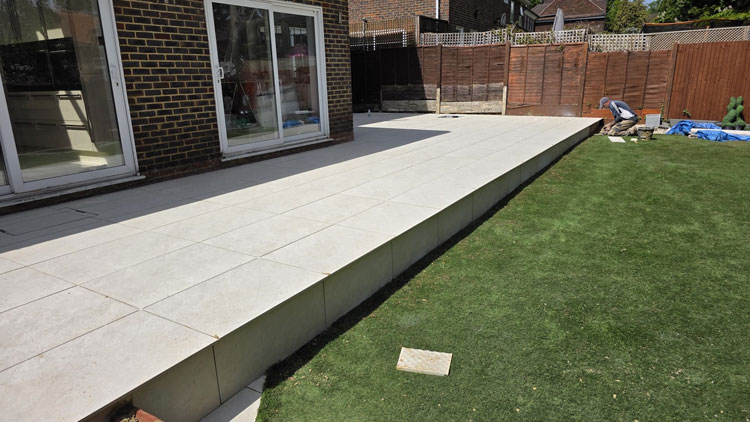
Choosing paving for a new patio can be surprisingly difficult. Porcelain looks clean and contemporary, while sandstone brings the colour and character of natural stone. Both can create a beautiful, long-lasting outdoor space, but they behave differently and suit different gardens.
For homeowners in Plymouth, the decision is not only about appearance. A patio also needs to cope with regular rain, changing temperatures, everyday foot traffic and the amount of maintenance you are prepared to do.
So, is porcelain or sandstone better for your patio? There is no single answer for every home. Porcelain is usually the stronger choice if you want a consistent, low-maintenance finish. Sandstone is often better if you prefer natural variation, a softer traditional look and the character that develops as stone ages.
This guide compares the two options side by side so you can choose a surface that suits your garden, your property and the way you plan to use the space.
Porcelain vs Sandstone Paving: Quick Comparison
| Feature | Porcelain paving | Sandstone paving |
| Appearance | Clean, uniform and contemporary | Natural variation with a softer, more traditional character |
| Colour consistency | Very consistent within a range | Every slab can vary in tone and markings |
| Water absorption | Very low | More porous than porcelain |
| Maintenance | Generally low | Usually needs more regular cleaning and may benefit from sealing |
| Stain resistance | Generally high | More likely to absorb spills if left untreated |
| Installation | Requires careful preparation, accurate cutting and correct bonding | Requires skilled laying to manage natural variation in thickness and texture |
| Best suited to | Modern, low-maintenance patios and clean design schemes | Traditional gardens, period-style properties and natural planting schemes |
| Upfront cost | Often higher once specialist installation is included | Often lower than porcelain, depending on the stone and specification |
Short answer: choose porcelain if easy maintenance, consistency and a modern finish matter most. Choose sandstone if you value natural colour variation, texture and a more traditional feel. Good installation matters just as much as the material itself.
What Is Porcelain Paving?
Outdoor porcelain paving is manufactured from refined clay and minerals that are fired at very high temperatures. This produces a dense, hard-wearing slab with very low water absorption. Modern outdoor porcelain is available in a wide choice of colours and finishes, including designs that imitate limestone, sandstone, concrete and other natural materials.
Because porcelain slabs are manufactured, their dimensions and appearance are usually very consistent. This makes them particularly well suited to contemporary patios, straight lines and designs where a neat, uniform finish is important.
What Is Sandstone Paving?
Sandstone is a natural stone, so each slab has its own variation in colour, grain and texture. That variation is part of its appeal. Rather than creating a perfectly uniform surface, sandstone gives a patio a more organic appearance that can blend naturally with planting, lawns, brickwork and older properties.
Indian sandstone is widely used for UK patios, but sandstone is available in different grades, colours and finishes. The quality of the stone, calibration and installation can all affect how the finished patio performs.
Which Looks Better: Porcelain or Sandstone?
This is mainly a question of style rather than performance.
Porcelain works particularly well with modern extensions, rendered walls, bi-fold doors, minimalist planting and outdoor spaces where you want clean lines. Large-format slabs can also make a patio feel calm and uncluttered.
Sandstone has a warmer and more individual appearance. Its natural colour changes and surface texture often suit brick houses, traditional gardens and properties where a completely uniform paving finish would feel too formal.
Neither option is automatically more attractive. A good patio should feel as though it belongs with the house rather than looking like a separate feature added afterwards.
If you are still exploring layouts as well as materials, see our garden paving ideas for Plymouth outdoor spaces.
Which Is Better for Plymouth’s Wet Weather?
Plymouth gardens need paving that can perform well through frequent wet conditions. Both porcelain and sandstone can be suitable when the correct outdoor product is chosen and the patio is laid with appropriate falls and drainage.
Porcelain has very low water absorption, so it is less likely to take in moisture or staining. It can therefore be an appealing choice for homeowners who want a surface that is straightforward to clean after rain, muddy footprints or outdoor dining.
Sandstone is naturally more porous. It can absorb moisture and may gradually weather or change in appearance. For many homeowners that ageing is part of the material’s character, but it does mean sandstone generally needs a little more care.
Important: no paving material should be assumed to be slip-proof simply because of what it is made from. For any patio, choose a product specifically designed for outdoor use with an appropriate textured finish, and keep the surface clean of algae and organic growth.
Is Porcelain Slippery When Wet?
Good-quality outdoor porcelain is designed with a textured surface to provide grip. It is very different from smooth indoor porcelain tiles. However, slip resistance varies between products and finishes, so the exact paving specification matters.
A shaded patio can also become slippery if dirt, algae or leaves are allowed to build up, regardless of whether the surface is porcelain or natural stone. Correct drainage and routine cleaning remain important.
Which Is Easier to Maintain?
Porcelain usually wins on day-to-day maintenance. Its low water absorption helps it resist many common stains, and the surface normally requires little more than sweeping and periodic cleaning with a suitable product.
Sandstone needs more attention. Because natural stone is porous, dirt and organic growth can become more noticeable over time, especially in damp or shaded areas. Depending on the stone, location and finish, a suitable breathable sealer may be recommended. Sealing is not a substitute for good installation or cleaning, but it can help reduce staining in some situations.
If low maintenance is one of your highest priorities, porcelain is likely to be the easier choice. If you are comfortable with natural weathering and occasional maintenance, sandstone remains a very practical patio material.
Which Lasts Longer?
Both porcelain and sandstone can last for many years when the material is suitable for outdoor use and the patio is built correctly. In practice, patio failures are often caused by problems below or between the slabs rather than the paving itself.
A strong sub-base, full mortar bed, suitable jointing, correct falls and effective drainage are all essential. Poor preparation can cause movement, loose slabs, failed joints or standing water even when premium paving has been used.
This is why choosing experienced patio installers in Plymouth is as important as choosing the paving material.
Is Porcelain More Expensive Than Sandstone?
Porcelain often costs more to install than standard sandstone, although the difference varies considerably between products and projects. The slab price is only part of the cost.
Porcelain requires accurate cutting and the correct bonding method, and complex layouts, steps and edges can add labour. Sandstone is often more economical to buy, but premium natural stone and intricate designs can also be expensive.
When comparing quotations, check whether they include the same excavation, sub-base, drainage, mortar bed, edging, jointing, waste removal and finishing work. A lower headline price is not necessarily better value if important preparation has been excluded.
For an evergreen comparison, it is better to request an up-to-date local quotation than rely on a fixed online price per square metre, as material and labour costs change over time.
Which Material Is Better for a Small Garden?
Both materials can work well in a compact Plymouth garden, but the visual effect can be different. Large-format porcelain in a restrained colour palette can make a small patio feel cleaner and less busy. Matching or coordinating the paving with indoor flooring can also create a stronger sense of flow from the house into the garden.
Sandstone can make a small garden feel softer and more established, especially when combined with planting, timber fencing or brick walls. If the garden already contains a lot of natural texture, sandstone can help the patio sit comfortably within it.
Which Is Better for a Traditional Plymouth Property?
Sandstone is often the easier fit for older or more traditional homes because its colour variation and texture feel naturally established. It works well alongside brick, stone walls, cottage-style planting and traditional garden features.
That does not mean porcelain cannot work with an older property. Stone-effect porcelain in warmer, softer tones can create a useful middle ground: the easier maintenance of porcelain without an overly modern appearance. The key is choosing a finish that complements the building rather than following a trend in isolation.
Which Is Better for a Modern Patio?
For crisp, contemporary garden design, porcelain is usually the more obvious choice. Its consistent sizing makes narrow joints and clean geometry easier to achieve, while the range of neutral grey, beige and stone-effect finishes works well with modern outdoor furniture, rendered walls and architectural planting.
Sandstone can still be used in a contemporary scheme, particularly in a single-colour calibrated finish. It simply produces a more natural, varied result.
What About Installation?
Neither material should be treated as a simple “lay it and forget it” product. Each has its own installation requirements.
Porcelain paving is dense and has very low water absorption, so correct priming and bonding are essential. It also requires suitable cutting equipment and careful handling around edges and corners.
Sandstone paving can vary slightly in thickness and surface texture, so good installers adjust the laying bed to create an even finished patio while preserving the natural character of the slabs.
For either material, correct levels, drainage and a properly prepared foundation will have a major influence on the finished result and lifespan.
Porcelain or Sandstone: Which Should You Choose?
A useful way to decide is to think about your priorities rather than asking which material is “best” in general.
- Choose porcelain if you want a clean, consistent finish and minimal routine maintenance.
- Choose porcelain if you have a contemporary property or want strong indoor-to-outdoor visual continuity.
- Choose sandstone if you prefer genuine natural variation and a softer, more traditional look.
- Choose sandstone if you like paving that develops character as it weathers.
- For either option, prioritise suitable outdoor paving, good drainage and professional installation over appearance alone.
Bespoke Driveways & Patios offers patio installation in Plymouth as part of our wider landscaping services in Plymouth. We can help you compare materials and plan a patio around the style, levels and practical needs of your garden.
Questions to Ask Before Choosing Your Patio Paving
- Do I prefer a uniform finish or natural variation?
- How much cleaning and maintenance am I willing to do?
- Is the patio sunny, shaded or particularly damp?
- Will the area be used mainly for relaxing, outdoor dining or frequent family use?
- Does the paving suit the style and age of the property?
- Are there steps, curves or complex cuts that affect installation?
- How will surface water drain away from the patio?
- Do I want the patio to coordinate with paths, walls, a driveway or other landscaping?
Planning a New Patio in Plymouth?
Porcelain and sandstone are both strong patio choices, but they create very different outdoor spaces. The right option is the one that matches your property, lifestyle, maintenance expectations and budget.
If you are unsure, looking at full-size samples in natural light and considering them alongside the colours of your house, walls and garden can make the decision much easier. It is also worth discussing drainage, levels and installation before choosing a slab purely for its appearance.
To discuss a new patio, explore our Plymouth paving and landscaping services or contact Bespoke Driveways & Patios for a free, no-obligation survey and quotation.
Frequently Asked Questions
Is porcelain or sandstone better for a patio?
Porcelain is often better for homeowners who want a consistent, low-maintenance surface, while sandstone is ideal if you prefer genuine natural variation and a traditional appearance. Both can make excellent patios when correctly specified and installed.
Is porcelain paving slippery in the rain?
Outdoor porcelain is manufactured with textured finishes designed for exterior use, but slip resistance varies by product. Choose paving intended for outdoor areas, make sure drainage is correct and keep the surface free from algae, leaves and other debris.
Does sandstone need to be sealed?
Not every sandstone patio has to be sealed, but sealing can be useful where extra resistance to staining is wanted. The correct product depends on the stone and desired finish. Always follow the paving supplier or manufacturer’s guidance.
Which paving is easier to clean?
Porcelain is generally easier to maintain because it has very low water absorption and resists many common stains. Sandstone is more porous and can require more regular cleaning, particularly in shaded or damp gardens.
Does porcelain paving fade?
Quality exterior porcelain is manufactured to provide stable colour and is generally very resistant to fading. Natural sandstone changes more visibly over time as it weathers, which many homeowners see as part of its character.
Which is cheaper, porcelain or sandstone paving?
Standard sandstone is often cheaper upfront, while porcelain may cost more because of the material and specialist installation requirements. Exact costs vary by product, patio size, access, groundwork, drainage and design, so compare detailed local quotations rather than material prices alone.
What is the best paving for a wet Plymouth garden?
Both can work well. Porcelain’s low water absorption makes it attractive for low-maintenance wet-weather use, while sandstone can also perform very well with suitable outdoor stone, correct falls and proper drainage. The quality of installation is critical for either material.
Can porcelain and sandstone be used with other landscaping?
Yes. Either material can be combined with lawns, planting, raised beds, garden walls, fencing and paths. Coordinating the patio with the wider garden usually creates a more considered result than choosing paving in isolation.